How rare is the Bicentennial Quarter?
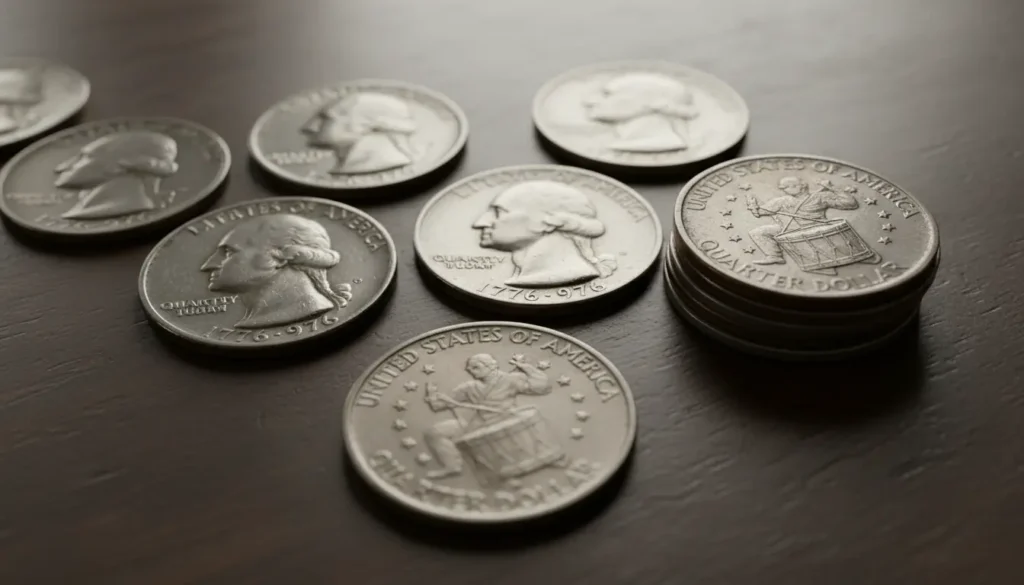
The Bicentennial Quarter, struck to mark the United States 1976 Bicentennial, is common in everyday change. Millions were minted for circulation and proofs. Most pieces are worth face value or a small premium to collectors.
Rarity depends on special circumstances. Only a tiny number of quarters become valuable when they have extreme condition, confirmed mint errors, or unusual provenance.
What makes a Bicentennial Quarter valuable?
Several clear factors determine value. Understanding these helps you judge whether a coin might be rare enough to interest serious collectors.
Condition and grade of a Bicentennial Quarter
Condition is the single strongest driver of value. Coins are graded on a 70-point Sheldon scale. Higher grades, especially near-perfect examples graded MS67+ or PR70 for proofs, command higher prices.
Even for common dates, an uncirculated or flawless proof Bicentennial Quarter can be worth more than face value to collectors.
Mint errors and varieties in the Bicentennial Quarter
Minting errors and striking varieties are often the most lucrative reason a Bicentennial Quarter gains value. Examples include:
- Double die obverse or reverse
- Off-center strikes
- Die cracks and cuds
- Clipped planchets or wrong planchet strikes
Errors that are dramatic and clearly authenticated usually fetch the highest premiums. Subtle anomalies may only add modest value.
Silver content and special issues
Some Bicentennial Quarters were issued as special 40% silver proofs or as part of collector sets. Those with silver content have intrinsic metal value and collector demand supporting higher prices.
But bullion alone rarely approaches very high collectible prices unless combined with rarity and great condition.
Could your Bicentennial Quarter be worth $1 million?
A $1 million value for a Bicentennial Quarter is extremely unlikely. Hitting that price would require several rare attributes to converge.
What would need to be true for a Bicentennial Quarter to be worth $1 million?
For a Bicentennial Quarter to reach near-million-dollar status, it would likely need to meet multiple conditions:
- Be a previously unknown and dramatic mint error or unique pattern not recorded in major references.
- Exist in perfect or near-perfect grade (PR70 or MS70), preferably authenticated by a top grading service.
- Have clear and provable provenance linking it to a historically important event or collection.
- Be supported by strong demand from top collectors or institutions willing to pay extreme prices.
Even when several of these conditions exist, reaching seven figures remains rare. Most high-value coin sales for US modern coins involve much scarcer dates or historically significant rarities.
How to check and protect a potentially valuable Bicentennial Quarter
If you suspect a Bicentennial Quarter in your pocket might be valuable, follow these practical steps.
- Examine the coin under a bright light and magnifier. Look for obvious errors, doubling, and surface condition.
- Compare to reliable references and official variety guides for the 1976 quarter series.
- Do not clean or polish the coin. Cleaning drastically reduces collector value.
- Place the coin in a soft holder or coin flip to prevent further wear.
- Seek a reputable coin dealer or a professional grading service for authentication and grading.
Grading and authentication add credibility and often increase the selling price, but they carry costs. Balance those costs against realistic value expectations.
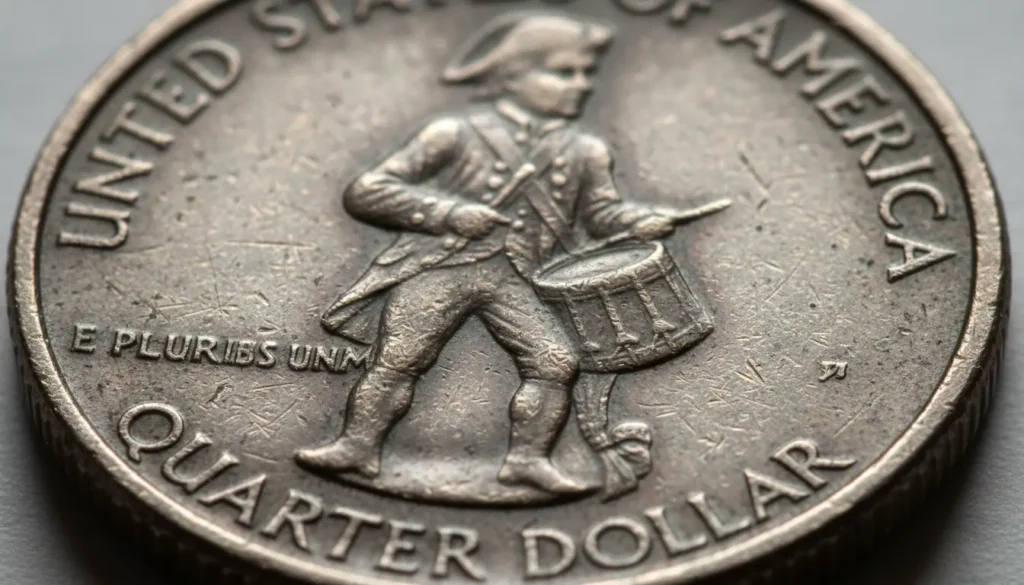
The 1976 Bicentennial Quarter design featuring a colonial drummer on the reverse was produced in massive numbers, yet a handful of mint errors and high-grade proofs still attract collector interest years later.
Real-world example: A plausible case study
Case study: A collector found a 1976-D Bicentennial Quarter with an apparent doubled design on the reverse. After researching similar varieties and consulting an experienced dealer, the collector submitted the coin for third-party grading.
The coin received a recognized grade and error attribution, then sold at auction for several thousand dollars. The sale showed how condition, clear error identification, and professional grading can convert a pocket find into a valuable collectible — though not typically into a million-dollar item.
What to do if you think you have a high-value Bicentennial Quarter
Be practical and methodical. Follow these actions to maximize the chance of a fair outcome.
- Document the coin with sharp photos from multiple angles.
- Get an independent opinion from at least one reputable coin dealer.
- Consider third-party grading from PCGS, NGC, or ANACS for important pieces.
- If selling, use reputable auction houses or established online coin marketplaces with buyer protections.
Final thoughts
While most Bicentennial Quarters are common and worth face value, a small subset can be valuable due to errors, condition, or special issues. A $1 million value is extremely rare and would require a unique combination of factors and strong collector demand.
If you find a quarter that looks unusual, take careful, documented steps to have it authenticated before assuming large value. Practical, measured action will protect both the coin and your potential return.