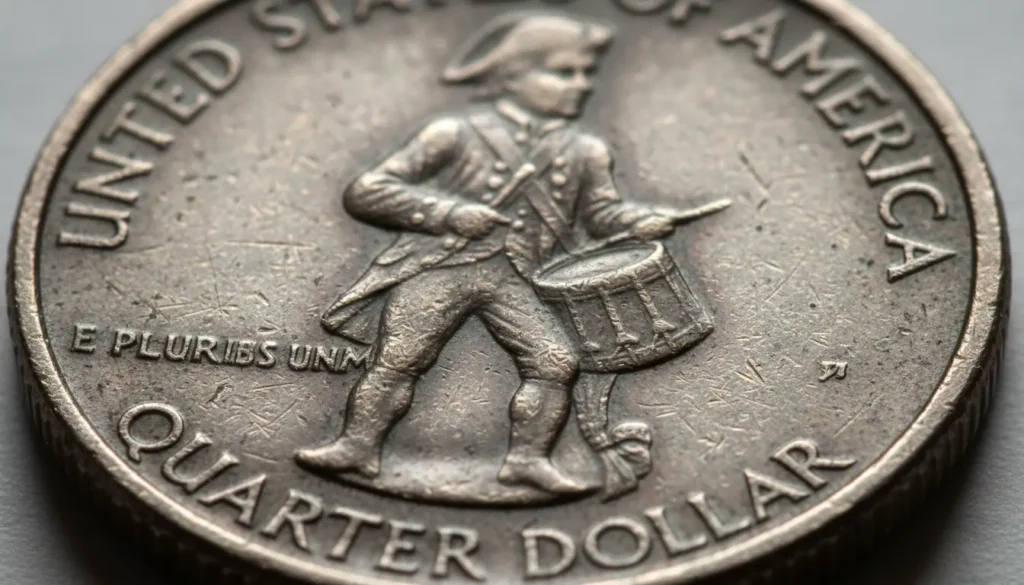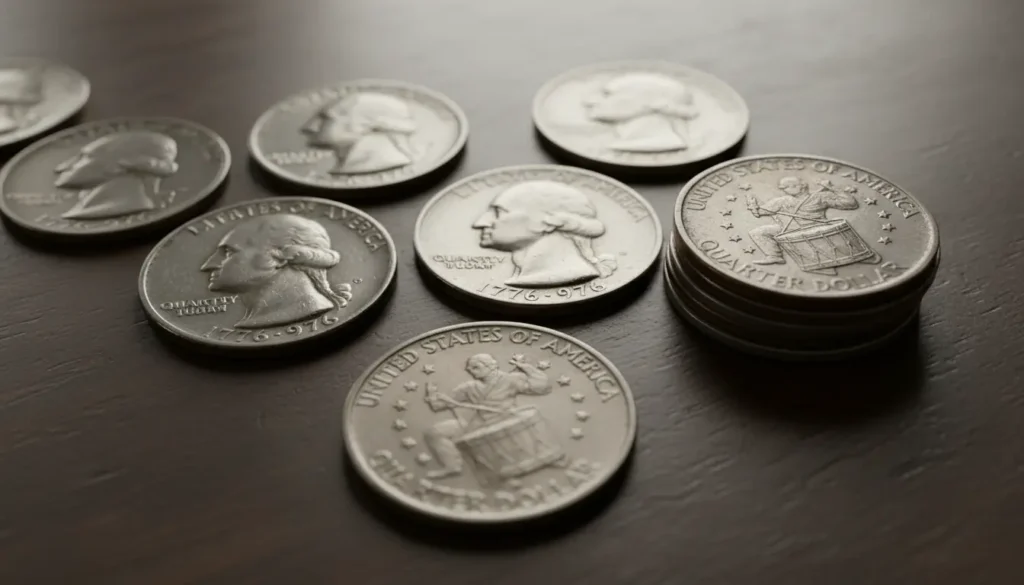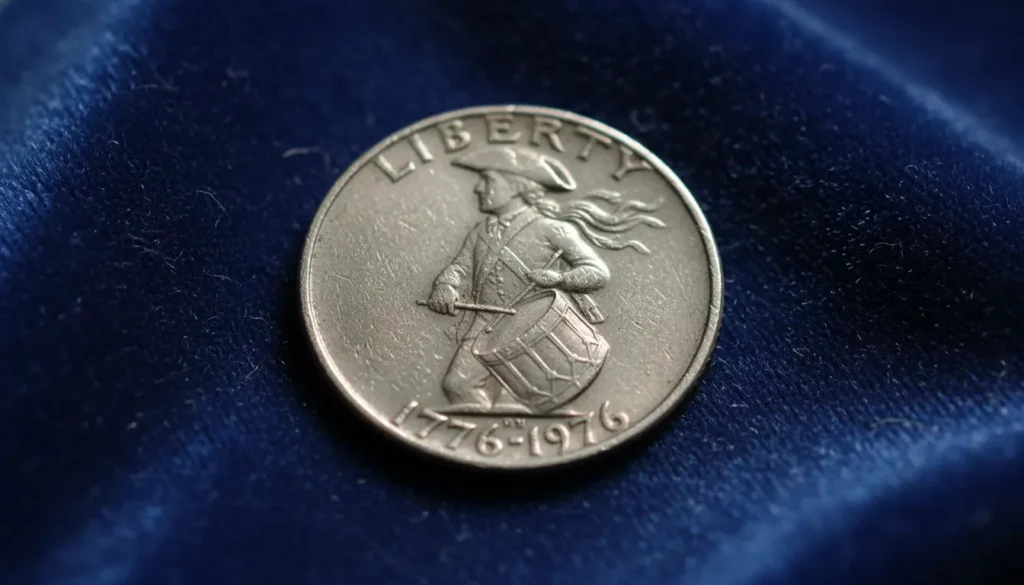
What is the Bicentennial Quarter?
The Bicentennial Quarter was issued in 1975–1976 to celebrate the 200th anniversary of American independence. It features a special reverse design showing a colonial drummer and the dual date 1776–1976. Millions were minted in circulation, proof, and special silver-clad sets.
Because so many were made, most Bicentennial Quarters are common and worth only face value or modest premiums. But a few specific factors can make any common coin suddenly interesting to collectors.
How could a Bicentennial Quarter be worth $1 million?
Reaching a price of $1 million for a Bicentennial Quarter is extremely unlikely, but not theoretically impossible in numismatics. Three conditions would need to combine:
- Unique rarity: a one-of-a-kind error or an unrecorded variety.
- Absolute condition: a flawless grade (for modern coins typically a PR70 or MS70) or a singular strike variant.
- Provenance and strong collector demand: documented history that excites high-end collectors or museums.
In modern coin collecting, rarities that approach seven-figure prices are usually early U.S. issues, unique pattern coins, or very rare errors with strong provenance. A mass-produced 1976 quarter would have to be an exceptional and provable anomaly to reach that level.
Error types that increase value for a Bicentennial Quarter
Certain error types can make a Bicentennial Quarter far more valuable than face value. Look for:
- Off-center strikes: significant offsets showing incomplete images.
- Wrong planchet or foreign planchet: a coin struck on a non-quarter blank.
- Double die or doubled devices: clear, consistent doubling on letters or design elements.
- Die cracks and die breaks forming unusual raised features.
- Mintmark anomalies or repunched mintmarks (RPM) that are well-documented and scarce.
Even with an error, the final value depends heavily on how many identical errors exist and the coin’s grade.
How to check your pocket change for a rare Bicentennial Quarter
Follow these practical steps to examine coins safely and accurately.
- Handle coins by the edges to avoid fingerprints and oil transfer.
- Use a bright light and a 10x loupe or smartphone macro lens to inspect details.
- Compare suspicious features to reliable references: coin guides, error databases, and auction records.
- Take clear, well-lit photos showing obverse, reverse, edge, and any anomalies.
- If you believe the coin is rare, seek an independent grading company or a reputable dealer for authentication.
What grading and authentication mean
Professional grading assigns a numeric grade and protects the coin in a sealed holder. Major companies include PCGS and NGC. A high grade from a respected service makes resale easier and often increases value significantly.
Authentication matters most for errors and unusual varieties. Expert authentication confirms the coin is not altered or a modern fabrication.
The U.S. minted over 1.6 billion Bicentennial Quarters in 1976 across all types, which is why most examples are common. Only clearly documented, rare errors or unique varieties gain serious collector value.
Real-world example and context
High auction prices for unique historic coins show how rarity and provenance drive value. For example, early American silver dollars and unique pattern coins have reached multi-million-dollar prices at auction because they are one of a kind and have strong historical provenance.
By contrast, modern commemorative coins like the Bicentennial Quarter require an extraordinary error or unique circumstance to reach even a small fraction of that value. Most documented Bicentennial Quarter auction sales fall in the range of a few dollars to a few thousand dollars for error specimens or high-grade proofs.
Case study: Finding and selling an error quarter
Jamie, a casual collector, found a Bicentennial Quarter with a clear off-center strike in a roll of change. Jamie photographed the coin, compared it to online error coin databases, and posted images on a collector forum. Members confirmed the off-center degree was significant.
Jamie then submitted the coin to a reputable dealer who recommended grading. After slabbed authentication and auction placement, the coin sold to a specialist buyer for several hundred dollars — well above face value but far from any million-dollar outcome. The process shows how careful documentation and authentication help realize value.
Practical tips before you sell
- Document: Take multiple photos and record where and when you found the coin.
- Research: Check auction results, error guides, and price databases.
- Authenticate: Use a recognized grading service for high-grade or very unusual finds.
- Choose the right venue: specialist auctions and dealer networks often yield better prices than general marketplaces.
Conclusion
Could a Bicentennial Quarter in your pocket be worth $1 million? Practically speaking, that outcome is extremely unlikely. However, certain documented and rare errors, unique varieties, or exceptional grades can make a Bicentennial Quarter worth far more than face value.
If you suspect you have a rare quarter, document it carefully, compare with trustworthy references, and seek professional authentication. That process gives you the best chance to realize any real value the coin might hold.