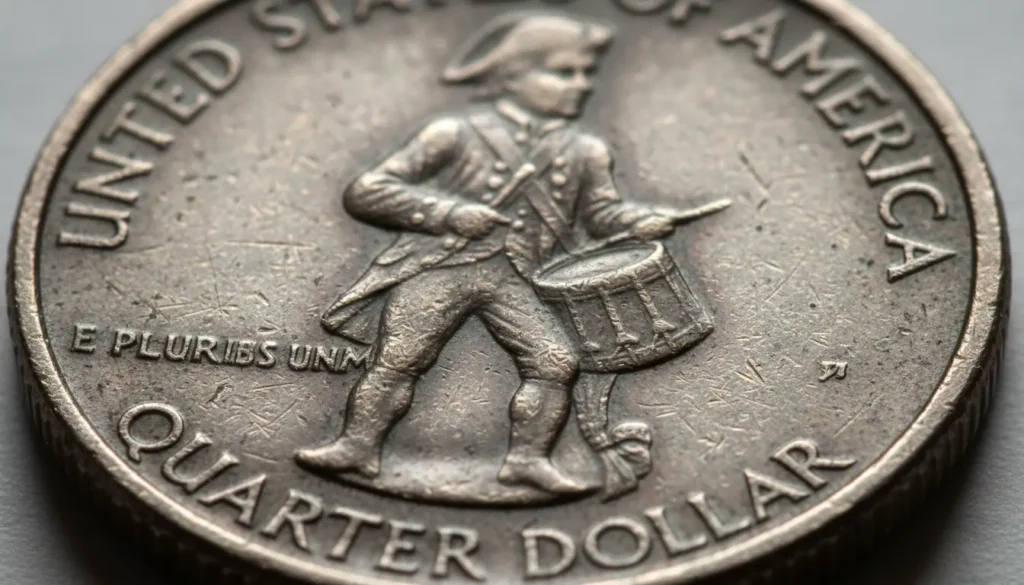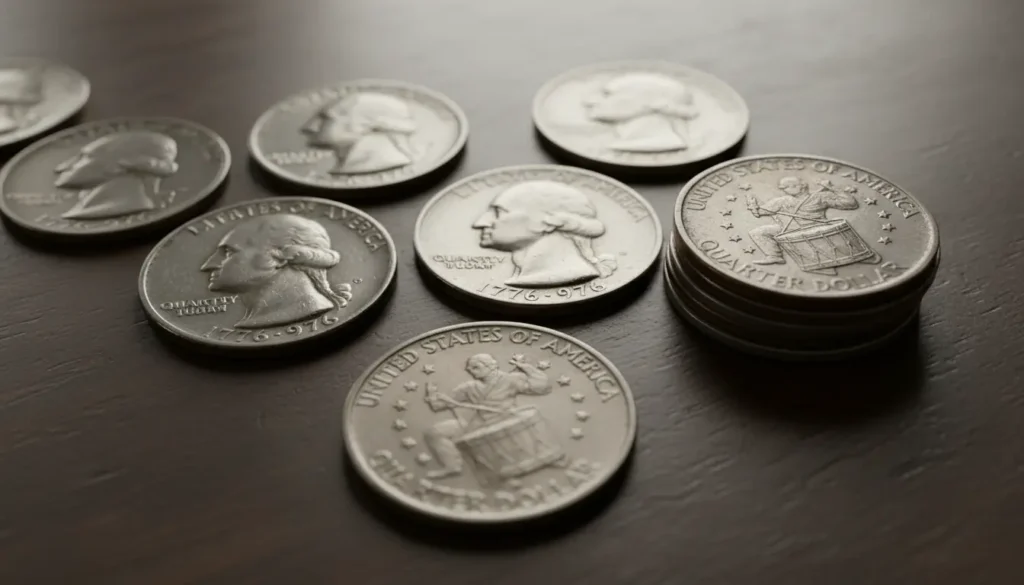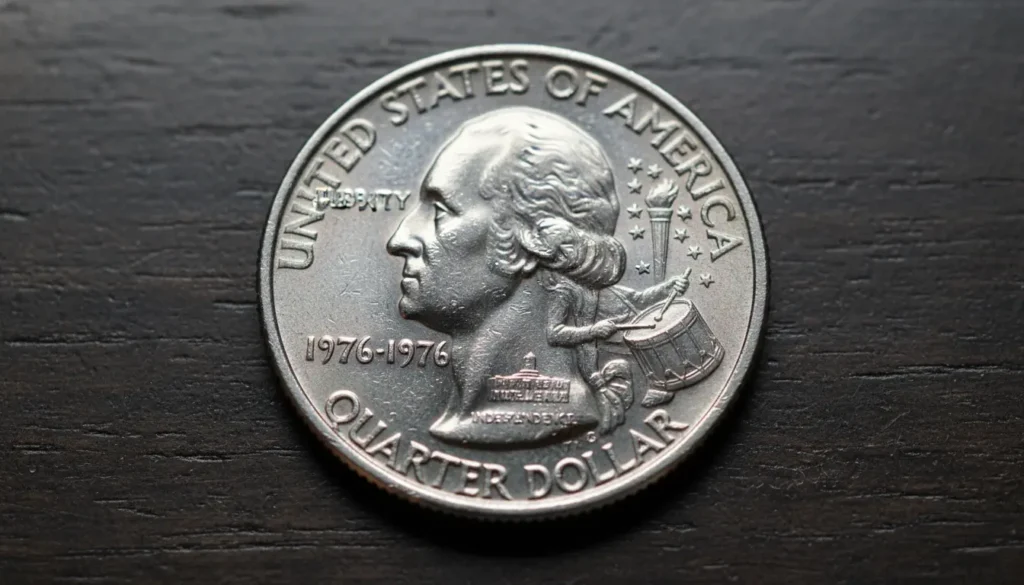
The 1976 Bicentennial Quarter is one of the most familiar modern U.S. coins because of its special 1776–1976 dual date and colonial drummer reverse. Most were produced for circulation and remain common. Still, collectors hunt for rare varieties and mint errors that can push value far above face value.
How rare is the Bicentennial Quarter?
The short answer: mostly common. Hundreds of millions of Bicentennial Quarters were struck in 1975 and 1976 for the nation’s 200th anniversary.
Widespread production means ordinary circulated pieces usually trade at or near face value. Collectible value rises for special strikes, 40% silver issues, proof coins, and mint errors.
Bicentennial Quarter mintages and silver versions
Several U.S. mints produced the Bicentennial Quarter in different formats. Some were standard clad circulation strikes, while collector sets included pieces struck in a 40% silver composition.
Key identifiers are the dual date 1776–1976 and the Washington obverse. Look for mint marks and proof finishes to separate standard circulation coins from collectible issues.
What makes a Bicentennial Quarter valuable?
Value rises when a coin differs from the mass-produced standard. Collectors pay premiums for:
- Silver composition (collector issues)
- High grade and perfect surfaces (MS or PR grades)
- Major mint errors (off-center, double die, clipped planchet, wrong planchet)
- Scarce die varieties or pattern coins with documented provenance
Common error types that increase value
Not every blemish is valuable. The most marketable errors are:
- Large off-center strikes where design elements are missing
- Double die obverse or reverse with clear doubling
- Clipped planchets and broadstrikes that produce unusual shapes
- Wrong metal planchet (e.g., a silver-clad quarter struck on a different blank)
These errors are graded and authenticated by services like PCGS and NGC for serious sale.
Could a Bicentennial Quarter be worth $1 million?
Highly unlikely, but not strictly impossible. To reach seven figures a coin would normally need to be absolutely unique, authenticated, and carry exceptional provenance or historical significance.
Examples of coins that sold for millions are typically unique patterns, extremely rare pre-1933 gold issues, or famous error coins with documented history. A modern 1976 quarter would need an extraordinary, one-of-a-kind error or direct link to a major historical story to approach that level.
Realistic value expectations
Typical price bands for Bicentennial Quarters:
- Circulated clad coins: face value to a few dollars
- Uncirculated and proofs: low tens to a few hundred dollars, depending on grade
- 40% silver collector issues (high grade): low hundreds to a few thousand dollars
- Major authenticated errors: thousands to tens of thousands of dollars — occasionally more for unique pieces
The Bicentennial Quarter reverse design features a Colonial drummer, created specifically for the 200th anniversary. The dual date 1776–1976 was used on quarters, half dollars, and dollars that year.
How to check your Bicentennial Quarter for rarity
Follow these practical steps to evaluate a find. Use basic tools and document anything unusual.
- Inspect the coin closely with a loupe or magnifier (10x recommended). Look for doubling, missing design areas, or off-center strikes.
- Weigh and measure the coin. Silver and clad pieces differ slightly in weight and appearance.
- Note the mint mark (if any) and finish. Proofs often have mirror-like fields and frosted devices.
- Photograph the coin clearly from multiple angles and document any unusual features.
- Seek authentication from a trusted grading service (PCGS, NGC) before marketing a high-value item.
When to seek professional help
If you see a dramatic mistake (large off-center strike, unusual metal, distinct doubling), stop handling the coin and consult a professional. Handling can damage high-grade surfaces and reduce value.
Submit coins for third-party grading only after initial photos and a dealer consultation if possible.
Selling a potentially rare Bicentennial Quarter
If you believe you have a valuable Bicentennial Quarter, follow a cautious route to maximize outcome.
- Get unbiased authentication and grading from a top service.
- Photograph the encapsulated coin and gather provenance details.
- Choose a sales channel: established auction house, specialist numismatic auction, or reputable dealer.
- Expect buyer fees and grading/consignment costs to reduce net proceeds.
Case study: A cautious path to market
A collector discovered an unusual Bicentennial Quarter with a pronounced off-center strike. After documenting the find, the collector sent high-resolution images to a local dealer who recommended third-party grading.
PCGS authenticated the error and assigned a grade and attribution. The coin was consigned to a specialist auction where dedicated collectors competed, resulting in a five-figure sale — well above typical prices but far below $1 million.
Final practical tips for collectors
Be realistic about odds. Most Bicentennial Quarters are common, and only a tiny fraction become high-value items.
Preserve potential finds, document them, and use professional grading and reputable sales channels. That is the reliable path to realizing maximum value.
Finding a million-dollar coin in pocket change is not impossible in theory, but it’s extraordinarily rare in practice. Treat any likely candidate carefully and get expert guidance.