Overview: The Bicentennial Quarter and value expectations
The Bicentennial Quarter (1976) was issued to mark the United States’ 200th anniversary. Millions were produced for circulation and collector sets. Most are common and worth face value to a few dollars.
This guide explains how to spot rare Bicentennial Quarter varieties or errors, what could — in extremely rare cases — push value into high ranges, and practical next steps if you think you found something important.
How to identify a Bicentennial Quarter
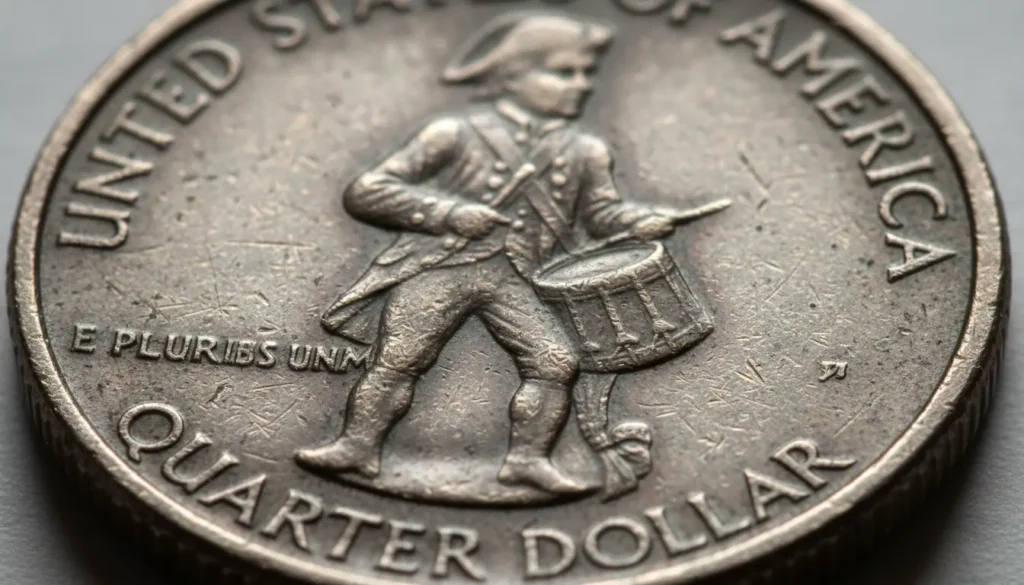
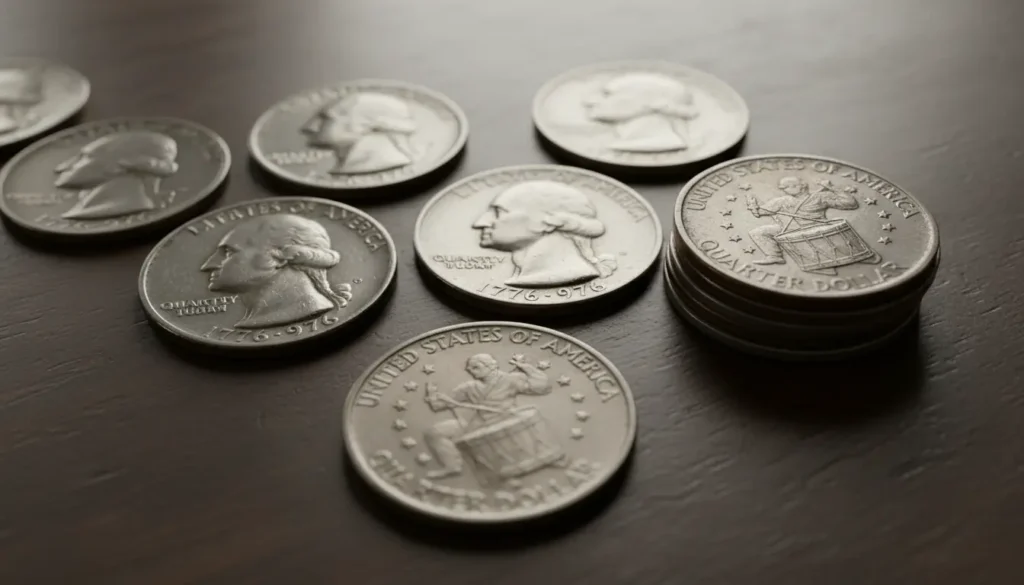
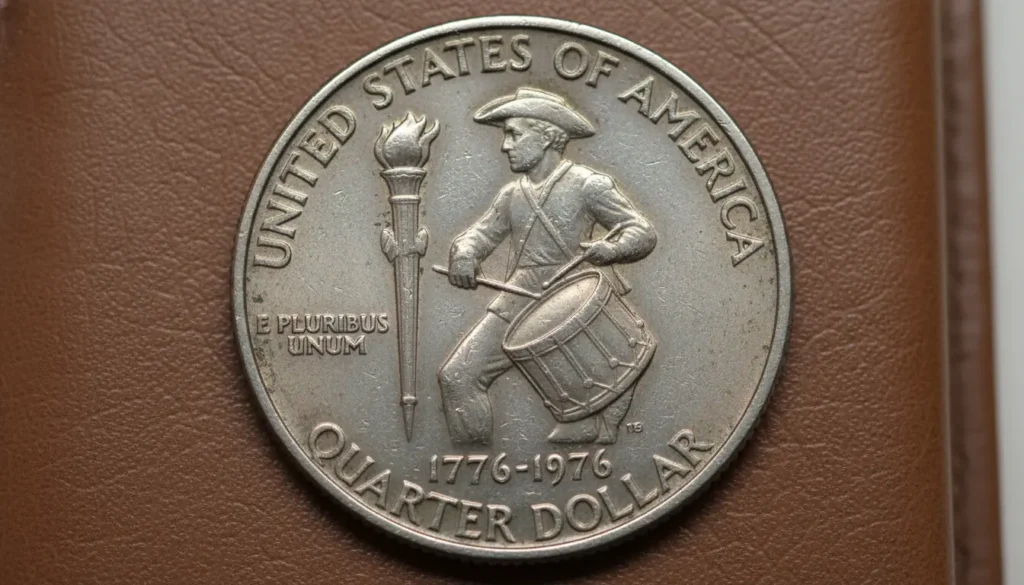
First, know what the coin looks like. The reverse features a Colonial drummer with a torch and 13 stars. The obverse keeps the Washington portrait. Mint marks (D or S) appear on some pieces.
Design features to check on a Bicentennial Quarter
- Reverse image: Colonial drummer, torch, and 13 stars.
- Obverse: Washington portrait and date indicated as 1776–1976 on Bicentennial issues.
- Mint mark: Look near the obverse or reverse depending on the strike (D for Denver, S for San Francisco; Philadelphia pieces may show no mint mark).
What makes a Bicentennial Quarter valuable
Several factors influence value: rarity, condition (grade), silver content, and unique mint errors. Most Bicentennial quarters are common, but certain versions and mistakes attract collectors.
Common value drivers
- Silver content: 1976-S silver proof quarters in collector sets were struck in 40% silver. These can be worth more than clad circulation pieces.
- High grade: Uncirculated or proof coins graded MS/PR 65 and higher increase value, with top grades commanding the best prices.
- Mint errors: Off-center strikes, double dies, clipped planchets, and broadstrikes are error categories that can raise collector interest.
How realistic is a $1 million Bicentennial Quarter?
Short answer: Very unlikely. Bicentennial quarters were produced in large numbers. For a 1976 quarter to reach seven figures, it would need to be a unique, documented error or an otherwise one-of-a-kind coin with extraordinary provenance and demand.
Most market outcomes are modest: common circulated coins are face value, common uncirculated pieces sell for a few dollars to low hundreds, and high-grade proofs or silver pieces might fetch hundreds to a few thousand. Exceptional error coins can climb higher, but a $1 million sale would be extraordinary and nearly unheard of for this series.
How to check and document a potentially valuable Bicentennial Quarter
If you believe you have a special Bicentennial Quarter, follow a methodical approach. Documentation and professional grading matter a lot in the collector market.
Step-by-step checklist
- Handle carefully: Use gloves or hold by the edge to avoid adding marks.
- Photograph: Take clear photos of both sides under good lighting, including close-ups of any anomalies.
- Research: Compare with online references and auction records to see if the variety or error is known.
- Get opinions: Ask experienced dealers or coin club members for initial feedback.
- Grade and authenticate: Submit the coin to a trusted third-party grading service (PCGS or NGC) for authentication and grading if evidence suggests high value.
Types of errors collectors watch for on Bicentennial Quarters
- Double die obverse or reverse — overlapping doubled devices or lettering.
- Off-center strikes — when the design is not fully struck on the planchet.
- Planchet errors — clips, laminations, or incorrect metal composition.
- Mintmark anomalies — repunched mint marks or missing mint marks on a variety where one is expected.
Where to sell or get an appraisal
Choose reputable venues. Major auction houses, established coin dealers, and online marketplaces with protections are viable options for significant coins. Small finds should start with local coin shops or club experts.
If the coin is graded by a recognized service, it will command better prices and wider trust among buyers.
The 1976 Bicentennial quarter’s reverse design was created by Jack Ahr and was used only in 1975–1976. Collector sets included special 40% silver proof quarters from San Francisco, distinguishable by their finish and mint mark.
Case study: A practical example
Example: A collector found a 1976-S quarter in a proof folder that looked unusually deep cameo. The collector photographed the coin, compared details online, and submitted it to a grading service.
After authentication and a high proof grade, the coin attracted interest among proof specialists. The seller worked with a respected auction house and received multiple bids. The sale achieved a price significantly above typical proof values, though far below the seven-figure threshold. The key takeaway: careful documentation and proper grading created a marketable result.
Final takeaways for collectors
- Most Bicentennial Quarters are common; treat finds calmly and follow verification steps.
- Errors and high-grade silver proofs are the realistic paths to elevated value.
- Authentication and grading by trusted services are essential before selling or insuring a valuable coin.
- Seek multiple opinions and use reputable dealers or auction houses for high-value items.
If you think you found a rare Bicentennial Quarter, document it, avoid cleaning or altering the coin, and consult professionals. While a one-million-dollar outcome is exceptionally unlikely, informed steps give you the best chance to realize the coin’s true market value.