Why people ask about the Rare Bicentennial Quarter
The 1976 Bicentennial Quarter marked 200 years of U.S. independence. It has a special reverse design and many were made, which usually keeps value low for common pieces.
Yet collectors and the public still wonder if any Bicentennial Quarter could be worth as much as $1 million. This article explains what would need to happen for that to be possible and how to check your coin.
What makes a Bicentennial Quarter rare?
Rarity comes from a combination of low surviving numbers, unique errors, or historical significance. For Bicentennial Quarters, the usual valuable traits are:
- Unusual mint errors (off-center strikes, broadstrikes, wrong planchet)
- Unique die varieties (large or doubled die anomalies)
- Very high professional grades (near-perfect mint state or pristine proof examples)
- Silver composition examples from special mint sets (40% silver collector pieces)
Mint sets and silver Bicentennial Quarters
Most circulating Bicentennial Quarters are copper-nickel clad. However, the U.S. Mint produced 40% silver Bicentennial Quarters for special proof and uncirculated sets. Those silver pieces are more valuable than regular circulation examples, but they are not automatically worth huge sums.
Could a Bicentennial Quarter reach $1 million?
In practice, hitting $1 million requires an extreme combination of rarity, condition, and demand. Examples that reach seven figures are typically unique, historically important, or have an unbroken, compelling provenance.
For a modern coin like a Bicentennial Quarter to sell for $1 million, one of these would likely be true:
- A one-of-a-kind, dramatic mint error that is authenticated and unrepeatable.
- An example owned and documented by a major historical figure or tied to a major event.
- An unreported discovery of a very small quantity of silver specimens with a verifiable error that excites collectors.
Realistic value expectations
Most Bicentennial Quarters, even in excellent grade, sell for a few dollars to a few hundred dollars. Silver proofs and certified high-grade coins can sell for more, often in the low hundreds to low thousands, depending on condition and market interest.
So while a seven-figure sale is not impossible in theoretical terms, it is extremely improbable for this series without an exceptional story or discovery.
How to examine a potential Rare Bicentennial Quarter
If you think you have a valuable Bicentennial Quarter, follow these steps to assess and protect it.
- Do not clean the coin. Cleaning can destroy value and surface details used for grading.
- Photograph both sides with good lighting and a scale or ruler for size reference.
- Check for obvious errors: off-center strikes, clipped planchets, double dies, or wrong metal color.
- Look for mint marks: ‘D’ for Denver, ‘S’ for San Francisco. Philadelphia issues often lack a mint mark.
- Compare to reference photos from PCGS, NGC, or major numismatic guides online.
When to get professional help
If your photos show an obvious or dramatic error, or if the coin looks uncirculated and special, consult a reputable dealer or submit the coin for third-party grading. Grading companies such as PCGS and NGC can authenticate and grade the coin.
Bring good documentation and avoid quick online sales without verification.
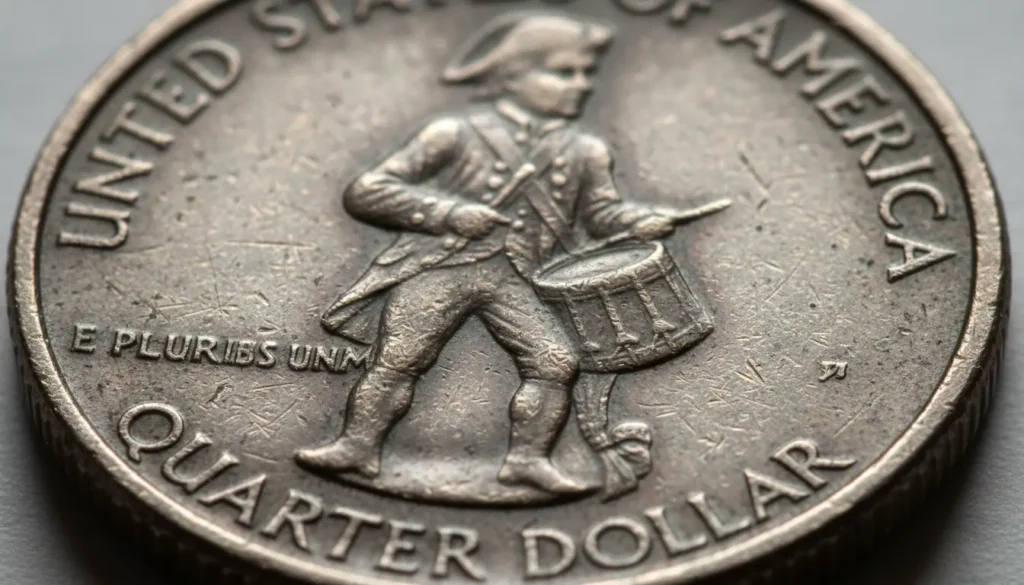
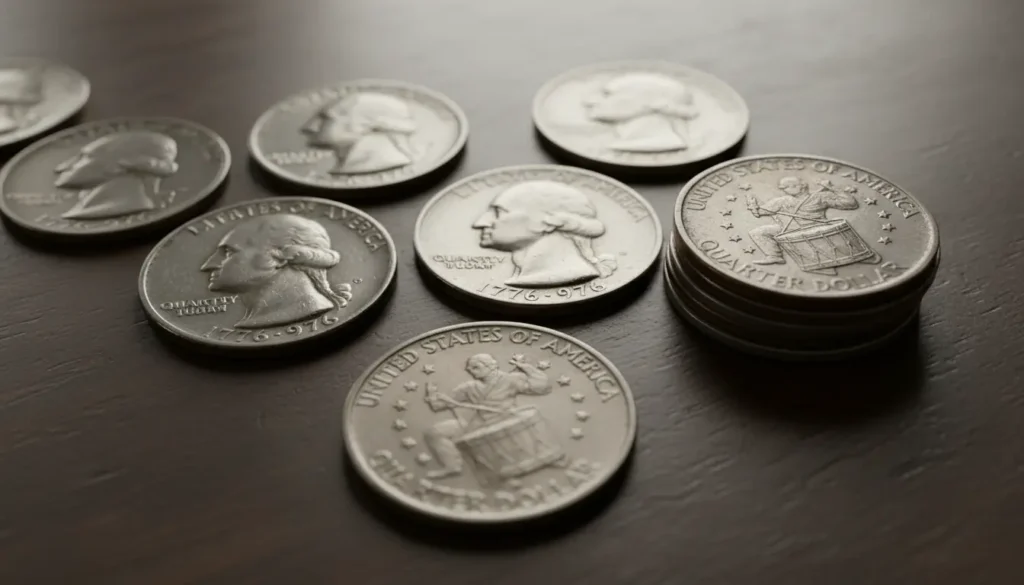
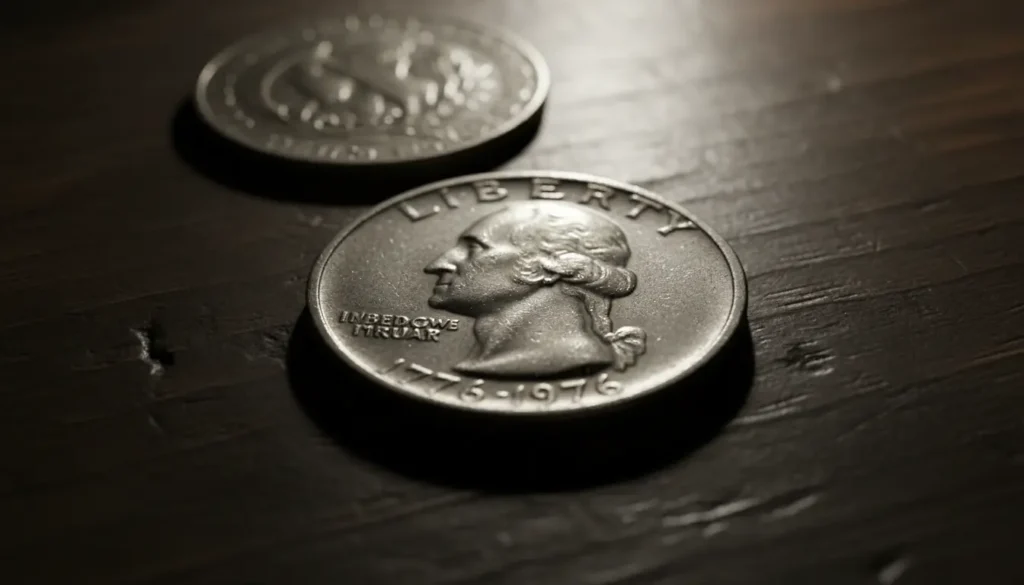
The Bicentennial design was used on quarters, half dollars, and dollars struck in 1975 and 1976. The quarters show a colonial drummer and the dual date 1776-1976 on the obverse.
Common valuable Bicentennial Quarter error types
Understanding error types helps you spot potentially valuable coins. Common error types collectors seek include:
- Off-center strike: Part of the design is missing due to misalignment.
- Clipped planchet: A coin missing a curved section from improper blanking.
- Doubled die: Design elements appear doubled due to a die problem.
- Wrong planchet: A quarter struck on the wrong metal blank (rare for modern coins).
Case study: A notable Bicentennial find
A collector once found a heavy off-center Bicentennial Quarter in a box of change. After photographing and verifying the error, the collector submitted the coin to a grading service. The authenticated off-center strike attracted interest at a specialist auction and sold for several thousand dollars.
This example shows the realistic path from discovery to sale: identify, document, authenticate, and auction through reputable channels.
Practical tips if you find a rare Bicentennial Quarter
- Stop using or handling the coin frequently; oils and scratches reduce value.
- Place the coin in a soft, inert holder or flip with acid-free material.
- Get high-resolution images and multiple angles for documentation.
- Consult multiple opinions from established dealers before selling.
- Consider third-party grading and auction houses for top-tier sales.
Final takeaway: Could your pocket change be worth $1 million?
It is highly unlikely a typical Bicentennial Quarter from circulation would be worth $1 million. However, exceptional errors, unique provenance, or a truly one-of-a-kind discovery could make a modern coin unexpectedly valuable.
If you believe you have a rare Bicentennial Quarter, document it carefully and seek professional authentication. That is the only reliable route to determine true market value.
If you want, you can share clear photos and your observations and I will help you identify potential error types and next steps.