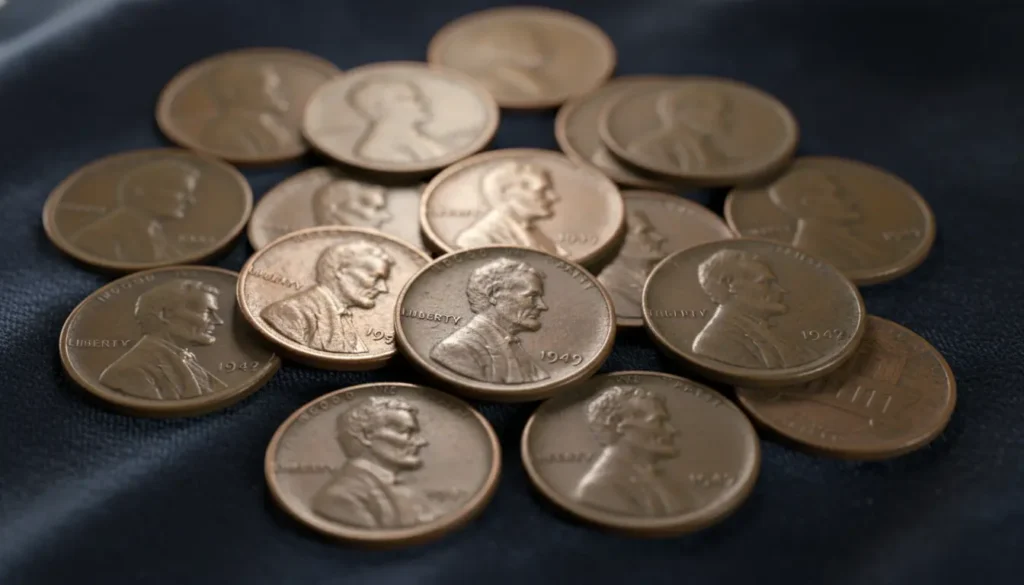
The Lincoln cent changed American collecting when introduced in 1909, and the twentieth century produced some of the most sought-after penny varieties and errors. This guide lists ten of the rarest and most collectible twentieth-century pennies, with identification tips and practical advice for collectors.
Top 10 Rare Pennies of the Twentieth Century — Short Guide
Each entry below names the coin, notes why it is rare, and gives basic identification tips. Values change with grade and market demand, so use these ranges only as starting points and consult a professional grader for high-value finds.
1. 1909-S VDB Lincoln Cent
Why rare: Low mintage and early controversy over designer Victor D. Brenner’s initials on the reverse make this a top collectible. Identification: Look for VDB initials on the reverse at the base of the wheat stalks.
- Typical survivors: higher demand in better grades.
- Value: from several hundred dollars in low grades to many thousands in mint state.
2. 1914-D Lincoln Cent
Why rare: Small Denver mintage and strong collector demand for key dates. Identification: Check the D mint mark on the obverse beneath the date.
- Key point: high-grade specimens are especially scarce.
- Value: frequently commands high premiums, especially in uncirculated condition.
3. 1922 (No D) Lincoln Cent
Why rare: Most 1922 cents were struck at Denver with a D; the “No D” varieties show no visible mint mark due to weak or filled dies. Identification: Absence of a D under the date or small remnants of a D can indicate a Denver-origin piece.
- Collecting note: mint state examples are far more valuable than circulated ones.
4. 1931-S Lincoln Cent
Why rare: Low San Francisco mintage makes this a classic key date. Identification: Look for the S mint mark under the date and assess strike quality and wear.
- Condition matters: even lightly worn examples sell for premiums.
5. 1943 Bronze/Copper Lincoln Cent
Why rare: Most 1943 cents were struck on zinc-coated steel due to wartime metal conservation. A few bronze (copper) planchets from previous production runs were accidentally struck, producing extremely rare coins. Identification: Bronze color and magnetic testing (bronze is not magnetic) will help separate these from 1943 steel cents.
- Extremely rare: few authenticated pieces exist and they often reach very high auction prices.
6. 1944 Steel Lincoln Cent
Why rare: After 1943 steel cents, the Mint returned to bronze, but a few 1944 cents were mistakenly struck on leftover steel planchets. Identification: Look for a silver-gray steel appearance and test with a magnet; verify with a trusted grading service.
- Rarity: similar status to 1943 bronze examples—treat with caution and verify authenticity.
7. 1955 Doubled Die Obverse Lincoln Cent
Why rare: One of the most famous doubled-die errors, readily visible doubling on the obverse date and lettering. Identification: Look at the date and the words IN GOD WE TRUST and LIBERTY for strong doubling.
- Collector tip: many circulated examples exist, but high-grade pieces are valuable.
8. 1969-S Doubled Die Obverse (Proofs and Specimens)
Why rare: A proof/set doubled die variety from San Francisco is scarce and sought by specialists. Identification: Sharp doubling on the obverse lettering and date; often found in proof or gem proof condition.
- Authentication: have proofs examined by experts to rule out later alterations.
9. 1972 Doubled Die Obverse Lincoln Cent
Why rare: Widely recognized doubled-die variety with prominent doubling on the obverse. Identification: Look for doubled date and doubled lettering; coins with clear doubling in high grade are preferred by collectors.
- Price: moderate to high depending on grade and clarity of the doubling.
10. High-Grade Common Date Wheat Cents (Key Condition Rarities)
Why rare: Some common-dated wheat cents are rare in high mint-state grades due to circulation wear. Identification: coins like late-1920s and 1930s dates in MS65+ are much scarcer than the raw mintage suggests.
- Collector strategy: condition rarities often offer a less expensive route to valuable holdings compared with key dates.
Many so-called “rare” pennies are only valuable in high grades. A well-preserved common date can sometimes be worth more than a low-grade key date.
How to Identify and Verify Rare Pennies
Basic checks anyone can do include mint mark inspection, color/metal tests (non-magnetic vs magnetic), and close examination for doubling or repunched mint marks. Use a 10x loupe and reference photos from trusted numismatic sources.
For high-value or uncertain finds, get third-party grading from services like PCGS or NGC and request specialist authentication for error coins and rarities.
Case Study: Finding Value in Circulation
A collector found a 1955 doubled die in a small change purchase at a flea market. The coin showed clear obverse doubling and was graded by a third-party service as an authentic doubled die in AU condition. The collector sold it to a specialist dealer at a significant premium versus face value.
Lesson: always check unusual lettering or doubled devices on circulated pennies before spending or discarding them.
Quick Tips for Collectors
- Use a magnifier and light to inspect dates and mint marks.
- Store coins in inert holders and avoid cleaning, which reduces value.
- When in doubt, get professional grading and authentication.
- Keep reference books or online databases handy for comparison photos.
These ten penny types and varieties capture the range of rarities from low mintage key dates to dramatic mint errors. Whether you are hunting circulated treasures or building a condition-sensitive set, careful inspection and verification are the collector’s best tools.